Birds
American Golden Eagle
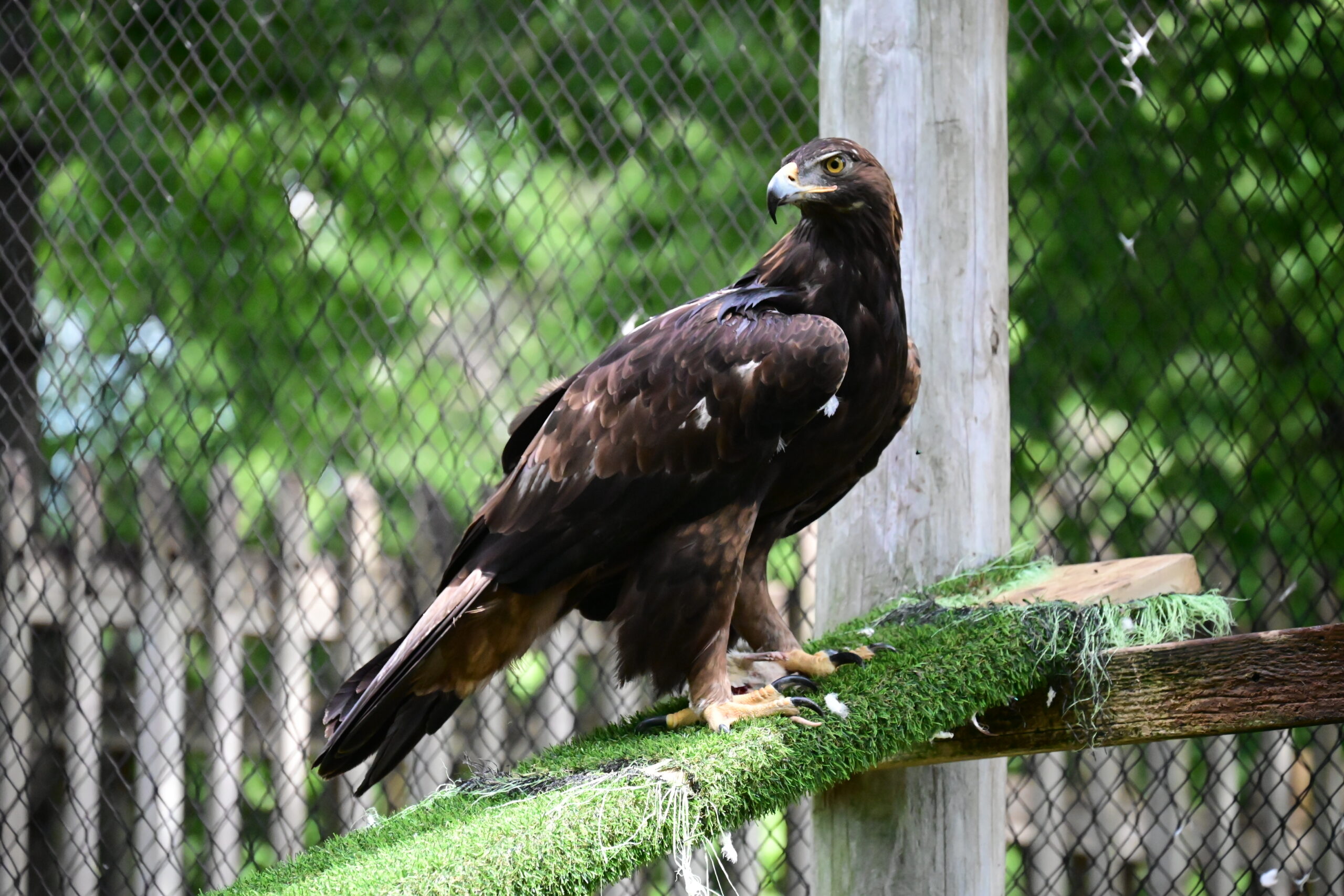 COMMON NAME: American Golden Eagle
SCIENTIFIC NAME: Aquila chrysaetos canadensis
TYPE: Bird
DIET: Carnivore
GROUP NAME: Convocation
LIFESPAN: 18 yrs
SIZE: 3.5 ft; wingspan - 7 ft
WEIGHT: Male- 6 lbs; Female - 13 lbs
STATUS: Stable
THREATS: Habitat loss and Poaching
FUN FACT: When in the air Golden Eagles swoop down at speeds up to 200 mph to catch their prey
Roseate Spoonbill
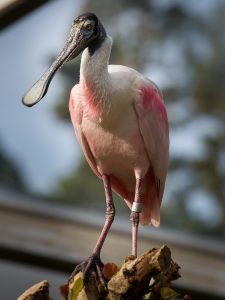 COMMON NAME: Roseate Spoonbill
SCIENTIFIC NAME: Platalea ajaja
This aquatic bird ranges from the Southeastern United States, through Mexico, to South America. They prefer habitats such as mangroves and coastal waterways, where they will forage in both fresh and salt water for crustaceans, small fish, insects, and some plants.
Much like the Flamingo, the rosy, pink color they are named for is thought to occur because of pigments within the crustaceans they eat.
Their spoon-shaped bill allows them to search through the mud, feel for a potential meal, and scoop it up without actually seeing it.
Courtship begins with a bit of sparring, leading to the clasping of bills. A pair will then present sticks to one another. The male will continue to provide sticks to the female, which she will use to construct a large, platformed nest.
The female typically lays two to three white, speckled eggs, which each parent will take turns incubating.
Fun Fact: Chicks are not born with a spoonbill. At around nine days old, their beak will begin to flatten and at about 40 days, they will begin to resemble that of an adult.
STATUS: Least Concerned
Cabot’s Tragopan
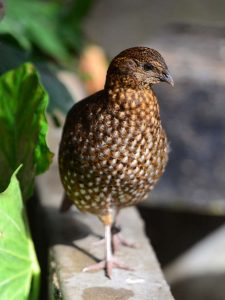 COMMON NAME: Cabot’s Tragopan
SCIENTIFIC NAME: Tragopan caboti
This Asian bird is found amongst the Himalayan Mountain Range, including areas of Northeast India, Central China, and into Myanmar and will migrate to lower elevations during winter months.
The male of the species performs an elaborate display during courtship. With their bright orange, white-dotted feathers puffed up, they inflate bright blue horn-like structures atop their head, as well as a radiant blue and red chin bib. They will then crouch down, fanning out their wings while chattering, before stretching and make themselves as tall as possible.
During the breeding season, a female may lay an orangish egg with brown spots, every other day for up to a month.
Fun Fact: The Tragopan belongs to the pheasant family. Unlike most pheasants, this species prefers to nest in trees rather than on the ground.
East African Grey Crowned Crane
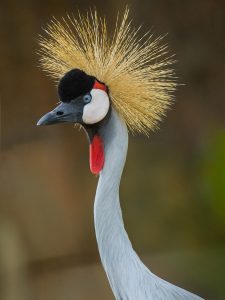 COMMON NAME: East African Grey Crowned Crane
SCIENTIFIC NAME: Balearica regulorum gibbericeps
Named for its striking crown of golden feathers, this crane can be found in parts of eastern and southern Africa, congregating in groups of up to 200.
They are monogamous and thought to mate for life. Breeding largely coincides with the rainy season. Elaborate courtship dances involving bows, jumps and wing flapping, are performed by both males and females. Each parent contributes to the rearing of chicks which are able to walk and even run as soon as they hatch.
These cranes are considered endangered in eastern Africa, due to the loss of wetland habitat and feeding grounds, as well as pesticide pollution.
Fun facts: They are the only crane species known to perch in trees.
Eastern Screech Owl
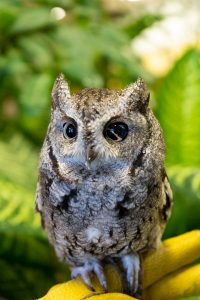 COMMON NAME: Eastern Screech Owl
SCIENTIFIC NAME: Megascops asio
The Eastern Screech owl is one of the smaller owl species, standing six inches tall on average. They are found on the Eastern coast of North America, as far west as Minnesota. They may have gray or reddish coloring, with a mottled appearance that provides camouflage amongst the forest trees they call home. They are nocturnal and will hunt in darkness in search of small mammals, reptiles, amphibians, fish & invertebrates.
Fun facts: The tips of owls' flight feathers have small, comb-like edges that help to baffle sound, making them nearly silent fliers and stealthy hunters.
Eurasian Eagle Owl
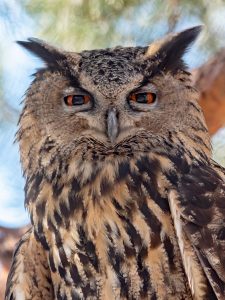 COMMON NAME: Eurasian Eagle Owl
SCIENTIFIC NAME: Bubo bubo
This bird of prey is one of the largest owls in the world, second only to the Blackiston’s Fish-Owl. They are known to inhabit a vast range, including much of Europe, Asia, and parts of North Africa. A common misconception is that this owl preys upon eagles. In fact, The Eurasian Eagle owl was named for its similarity in size to an eagle. These owls prefer a diet including small mammals, such as mice, voles, and rabbits.
Fun fact: The eye of an owl is not round, like a human’s. In fact, they are in the shape of a cylinder or tube. This is why an owl must turn its head to see, rather than simply rotating their eyes. Owls can swivel their heads up to 270 degrees.
Gray-necked Wood Rail
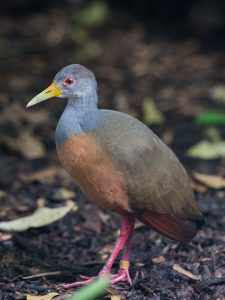 COMMON NAME: Gray-necked Wood Rail
SCIENTIFIC NAME: Armides cajaneus
The Grey-Cowled Wood Rail is typically found amongst the mangroves and swampland of Central and South America.
They utilize their elongated beak to hunt for crustaceans, and other small, aquatic animals such as frogs and snakes. They will also feed on seeds, fruits, and some vegetation.
They are monogamous, and a pair will nest together within dense vegetation. The female will typically lay between two to seven eggs, and hatchlings will fledge at around six weeks of age.
Fun Fact: When nesting, the male will leave in search of food during the night, and the female will forage during the day.
STATUS: Least Concerned
Scarlet Ibis
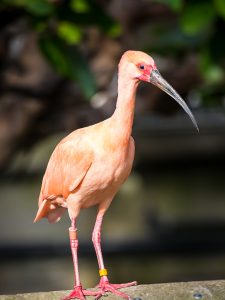 COMMON NAME: Scarlet Ibis
SCIENTIFIC NAME: Eudocimus ruber
TYPE: Bird
DIET: Carnivore
GROUP NAME: Flock
LIFESPAN: Wild - 16 yrs; Human Care - 20 yrs
SIZE: 2 - 2.5 ft; Wingspan - 3 ft
WEIGHT: 1.4 - 2 lbs
STATUS: Least Concern
THREATS: Habitat Loss and Poaching
FUN FACT: These birds have been found in ancient fossil records that date back 60 million years
Great Horned Owl
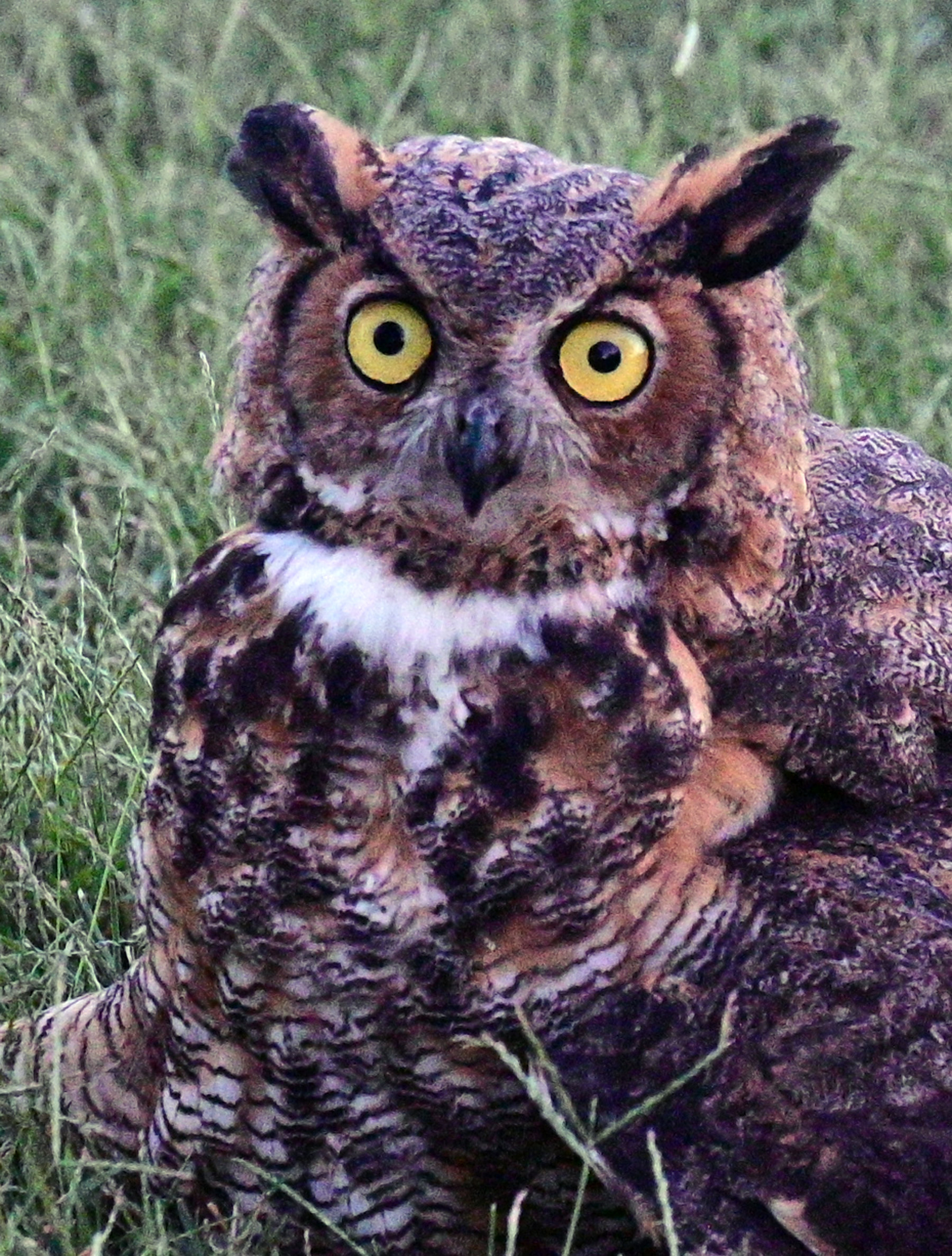 COMMON NAME: Great Horned Owl
SCIENTIFIC NAME: Bubo virginianus
The Great Horned Owl is named for the large tufts of feathers atop its head, resembling horns. These tufts are called ‘plumicorns.’ These Owls are found throughout the United States including much of Alaska, as well as Central and South America. Their diet consists largely of small mammals, reptiles and invertebrates and may also include other birds, including ducks, geese, and even smaller owls. They are the only bird of prey known to feed on skunks.
Fun fact: Owl’s will regurgitate indigestible material in the form of an ‘owl pellet.’ These oval shaped masses of bone and hair can be found on the ground near owl nesting sites and are a great way to discover what they've been eating.
STATUS: Least Concerned
Helmeted guinea fowl
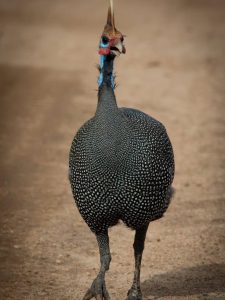 COMMON NAME: Helmeted guinea fowl
SCIENTIFIC NAME: Numida meleagris
This African bird has been domesticated and can be found on farms throughout the world. They are easily identified by their dark feathers, adorned with white speckles, as well as the blue and red color of their head and helmet-like casque.
They are omnivorous, with a diet including seeds, seedlings, fruits, invertebrates and small animals such as mice, lizards and frogs.
Gregarious in nature, they are known to come together in groups of several hundred.
This species is typically monogamous, and pairs will work together to raise their young. Females may lay a clutch of up to 20 eggs.
Fun Fact: Hens have been known to deposit eggs within the nests of other Guinea Fowl. This is known as ‘Egg Dumping.’
STATUS: Least Concerned
Nicobar Pigeon
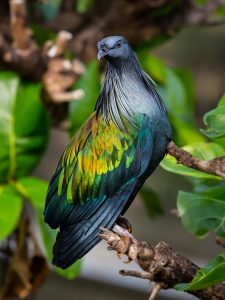 COMMON NAME: Nicobar Pigeon
SCIENTIFIC NAME: Caloenas nicobarica
This vibrantly plumed Asian bird is found amongst the low and wetland forests of the Nicobar Islands, New Guinea, Malaysia, Indonesia and the Philippines. They are instantly recognizable by their metallic, rainbow coloring and collar of long, thin feathers. Their diet mainly consists of fruits and seeds found on the forest floor. They have an internal gizzard that is capable of breaking down hard nuts which would be difficult for human to open without a tool.
Males and juveniles of the species will have brown eyes, while adult females will have white eyes.
Their current Conservation Status is Near Threatened. This is due to habitat loss because of deforestation for palm oil farming, hunting and the pet trade.
Fun facts: The Nicobar Pigeon is the closest living relative to the now extinct Dodo.
STATUS: Near Threatened
Wild Turkey
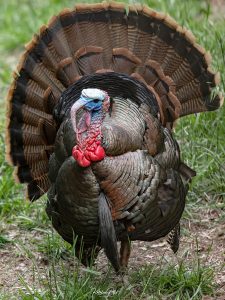 COMMON NAME: Eastern Wild Turkey
The North American Wild Turkey is adaptable to a variety of habitats including open forests, marshlands, and pastures. They spend their days foraging the ground for acorns, leaves, shoots, berries, insects, and even small vertebrates. At night, they roost among tree branches.
Larger, male turkeys can reach up to 25 lbs, with females averaging ten lbs. Despite their size, they are able to fly 55 mph in short bursts and run up to 25 mph.
This Wild Turkey boasts between 5,000 and 6000 iridescent feathers which reflect a range of color from bronze to green. The male is capable of altering the color of their head, neck and waddle to reflect their mood with a range including reds, blues and white.
Fun Fact: The Wild Turkey is one of only two birds native to the Americas that have been successfully domesticated, the other being the Muscovy Duck.
STATUS: Least Concerned
Violet Turaco
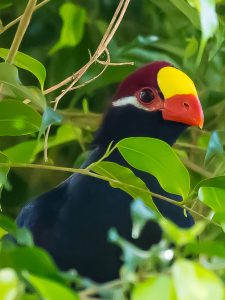 COMMON NAME: Violet Turaco
SCIENTIFIC NAME: Muscophaga violacea
Violet Turacos are named for the deep violet color of their feathers. They can be found within the tropical savannas, forests and wetlands of western Africa. They are considered frugivores, with a diet consisting mainly of fruits such as plantain and figs, supplemented with buds, flowers and insects.
Fun fact: Turaco species are the only birds with truly red or green feathers. Other birds either gain these pigments via their diet or reflect them via iridescence.
Rainbow Lorikeet
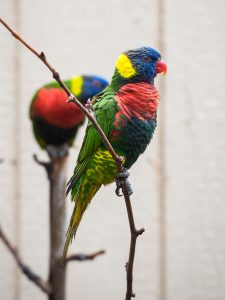 COMMON NAME: Rainbow Lorikeet
SCIENTIFIC NAME: Trichoglossus moluccanus
Native to Northern and Eastern Australia, the Rainbow Lorikeet is a brightly colored species of the parrot family.
As this species is typically found feeding on flower blossoms, it was long thought that nectar was their main source of food. It is now thought that flower pollen is the main staple of their diet. They will also feed on fruits and seeds, as well as the occasional insect.
They are known to congregate in large numbers and their communal chattering can make quite a noise, to the point that they are considered pests in some parts of Australia.
Fun Fact: The end of a Rainbow Lorikeet’s tongue resembles a bottlebrush and aids in the collection of pollen.
Redtail Hawk
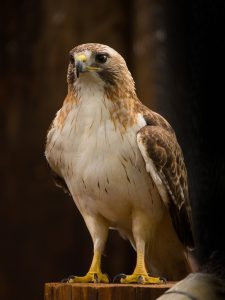 COMMON NAME: Redtail Hawk
SCIENTIFIC NAME: Buteo jamaicenis
The Red-Tail Hawk is commonly found across all United States except Hawaii, through Northen Canada and as far south as Panama.
They are adaptable to many different habitats such as plains, woodlands, and mountain regions. They hunt a broad range of animals, including rodents, hares, reptiles, fish, and other birds.
This species mates for life and will perform a courtship flight at the beginning of each breeding season. During this flight, the pair will chase one another, sometimes locking talons midair. They may return to the same nest year after year, working together to repair it.
Both the male and female will contribute to the rearing of young which may take up to four months after hatching.
Fun Fact: Like the Cooper’s Hawk and Sharp-shinned Hawk, this species is sometimes referred to as a “Chicken Hawk.” Though they are rarely observed feeding on domesticated Chickens.
White-cheeked Pintail
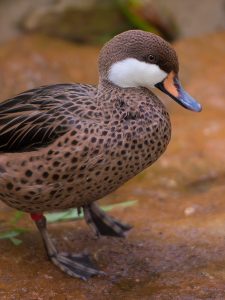 COMMON NAME: White-cheeked Pintail
SCIENTIFIC NAME: Anas bahamensis
The White Cheeked Pintail Duck prefers habitats, such as rivers, lagoons, and mangroves where fresh water meets the salt water of the sea. They have populations in South America, the Caribbean, and the Galapagos Islands.
They are Dabbling ducks, meaning they largely feed at or just below the water’s surface. Their diet includes aquatic plants, algae, seeds, and small invertebrates.
They typically form monogamous pairs and will breed year-round if conditions are favorable.
Fun Fact: While they do spend most of their time near the surface, they are capable of quickly diving several feet when evading a threat.
STATUS: Least Concerned
Turkey Vulture
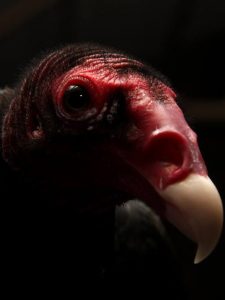 COMMON NAME: Turkey Vulture
SCIENTIFIC NAME: Cathartes aura
IDENTIFYING CHARACTERISTICS:
A turkey vultures’ wingspan can be up to 6 feet wide. They start life as an all-white chick but gain their brownish/black color as they mature. Vultures have no feathers on their head, legs, or feet because this allows them to remain clean even though they eat dead animals.
They can be identified in flight by the “V” shape to their wings when they soar, as apposed to all other birds of prey who hold their wings straight out to the sides when they are soaring.
RANGE:
Native Range for turkey vultures is from Canada to South America. With no feathers on their head, legs, or feet, turkey vultures must migrate south for the winter to avoid frost bite.
HABITAT:
These birds prefer open country but also visit urban areas daily in search of food. They roost at night in large family groups as they are strongly family oriented birds, and prefer their privacy!
NESTING:
Turkey vultures prefer cavities in ledges, hollows in trees, and the rafters of old barns for nesting. Their nests are simple with only enough sticks to prevent the egg from rolling away. They typically lay only 2 eggs.
FEEDING HABITS:
Unlike all other birds of prey, turkey vultures are not predators. They feed only on animals that are already dead and find them through their sense of smell that is so acute, it can smell a dead animal from up to 3 miles away. As scavenger animals, they will feed on almost any dead animal they find.
CONSERVATION STATUS:
Turkey vultures are common in their range, so are listed as “Least Concern” by the IUCN (International Union for Conservation of Nature).
Trumpeter Swan
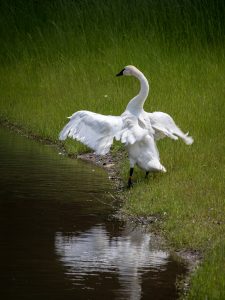 COMMON NAME: Trumpeter Swan
SCIENTIFIC NAME: Cygnus buccinator
Trumpeter Swans can be found in North America, with some traveling to breeding grounds in Alaska, Northwest Canada and the Great Lakes. In the winter months they will migrate in search of ice-free waters.
They are monogamous, forming bonded pairs as early as three or four years of age. They will reunite at the beginning of each breeding season and perform a courtship dance which is elaborate and unique to each pair.
The female is called a Pen, while the male is called a Cob. They will typically produce four to six offspring, called Cygnets, which will remain with their parents three to four months after hatching.
Fun Fact: Trumpeter Swans are the largest species of swan, as well as the largest waterfowl found in North America.